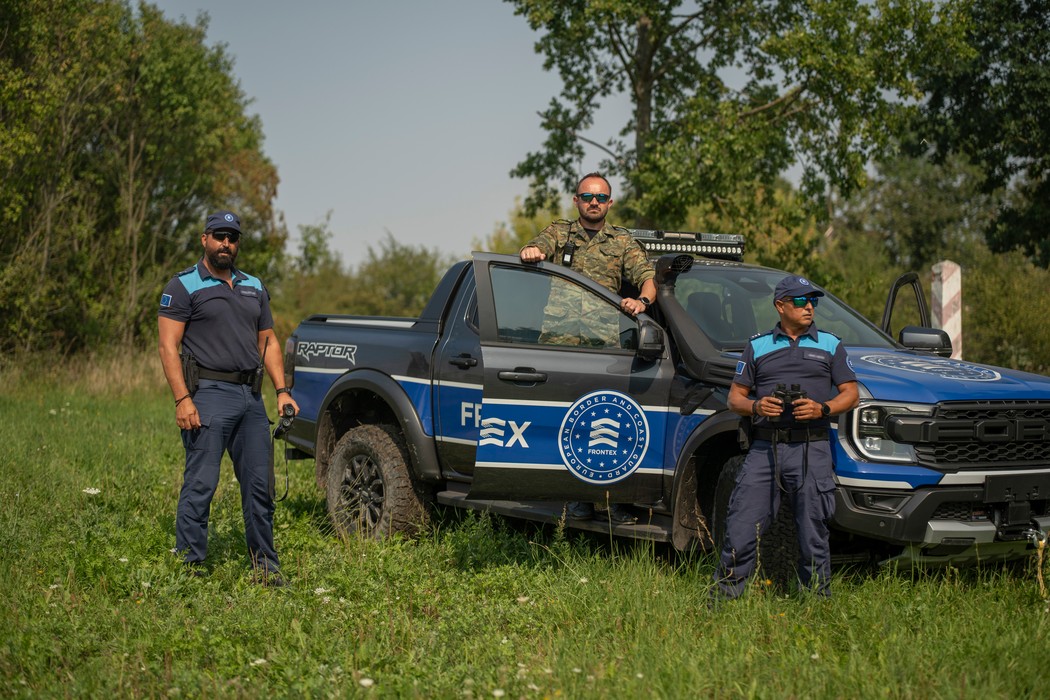
I would have gladly attended an on-site meeting with the Bulgarian Border Police or Frontex at the Bulgarian-Turkish border to have the situation explained to me directly. However, the Bulgarian Ministry of the Interior declined the request: by government decree, the border security facility there is classified as a strategic object of national security. Due to an ongoing police operation, strict filming and photography bans are in place to avoid making the protection system and the positioning of the deployment forces public. Furthermore, a bilateral agreement with Turkey prohibits photography near the border – doing so would be treated as a border incident.
The Bulgarian Border Police are highly visible in the region, sometimes up to ten kilometers away from the border. Twice I attempted to strike up a conversation with the officers on site. The first time, I was sent away rather abruptly; the second time, my passport was checked for ten minutes. After that, I didn't try any further.
But at least Frontex agreed to answer my questions in writing. Here are the questions and answers:
From a historical perspective, the borders in this region went from heavily militarized, dividing lines during the Cold War to integrated, cooperative European borders. How does Frontex define its modern role here, particularly in balancing high-tech security with humanitarian obligations and European values?
Frontex's role at EU external borders differs fundamentally from the traditional concept of borders as dividing lines. Today, European border management is based on cooperation, shared responsibility, and respect for EU law and fundamental rights. Modern border management combines operational support, technology, situational awareness and risk analysis with clear humanitarian obligations. For Frontex, effective border management and respect for fundamental rights go hand in hand. In every joint operation, including those in Bulgaria, fundamental rights obligations are clearly reflected in the operational plans. Frontex's support hinges on these principles being observed.
At the same time, Frontex supports the Member States. While the operational lead and primary responsibility remain with the national authorities, Frontex provides additional officers, technical equipment, expertise and coordination support.
What are currently the primary logistical and operational challenges Frontex face along the Bulgarian-Turkish and Bulgarian-Greek land borders?
The Bulgarian-Turkish and Bulgarian-Greek land borders present operational challenges. These include long stretches of border, difficult terrain in parts, and areas where surveillance and patrolling require specific equipment and coordination. Maintaining situational awareness across a large area, ensuring mobility in remote or difficult terrain, and adapting resources to changing migration patterns and cross-border crime are key challenges. Frontex supports Bulgaria by providing officers, patrol capacities, technical equipment, and specialised vehicles to help improve joint patrolling and operational flexibility. We are also supporting Bulgaria by providing Frontex officers to help combat border crime at the Kapitan Andreevo border crossing.
How does the daily operational cooperation between Frontex officers and the Bulgarian Border Police manifest on the ground, especially regarding language barriers, differing equipment, and joint patrols?
There is daily practical and close cooperation between Frontex officers and the Bulgarian Border Police. Depending on the needs defined in the operational plan, Frontex officers work alongside Bulgarian authorities in joint patrols, checks and operational support tasks.
To what extent is irregular migration and refugee movement at the Bulgarian-Turkish border still a major operational focus today? How does Frontex assist local authorities in managing these migration pressures on the ground?
The Western Balkan route remains an important area of operational attention, but the overall migratory pressure on this route has decreased significantly over the past two years. Irregular crossings on the Western Balkan route have fallen by more than 19% in the first four month comparing with the same period last year. Across the EU external borders overall, detections this year are also around 40% lower compared with the same period last year.
At the same time, migration routes can change quickly for different reasons. While pressure has decreased in the Western Balkans, increases have been observed in parts of the Central Mediterranean, particularly towards Italy from Libya and Tunisia.
This is why Frontex continuously adapts its support to where it is most needed. At the Bulgarian-Turkish border, the Agency assists the national authorities with additional officers, joint patrols, technical surveillance, risk analysis and operational coordination. The aim is to help manage migration pressure in an effective, proportionate and rights-compliant manner, while supporting Bulgaria in protecting the EU’s external border.
Fotos: Frontex