The fire dances in the remote villages of the Strandzha Mountains are no spectacle. They are deeply rooted in the traditions and faith of the local people. The Nestinari custom (Nestinarstvo) is millennia old, with its roots tracing back to Thracian mythology. The Thracians were an ancient people who once inhabited vast parts of Southeastern Europe – from present-day Bulgaria and Romania to northern Greece and European Turkey. They worshipped the sun god through spiritual fire cults. To this day, the climax of the ritual remains the dance of the Nestinari, performed barefoot on hot embers.
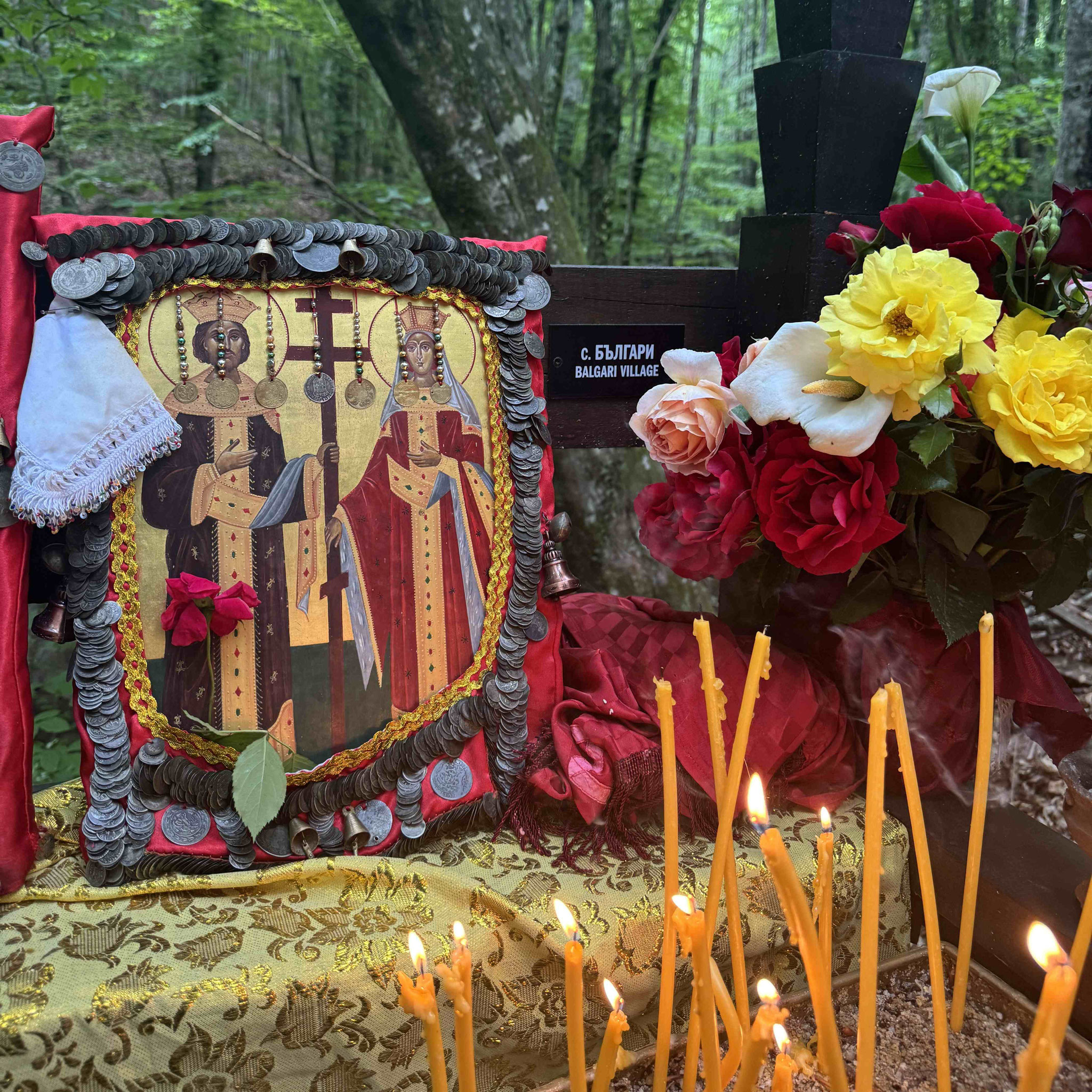
When Christianity arrived in the region during the Middle Ages, the pagan fire ritual merged with the new faith. The Thracian sun kings were replaced by the Christian saints Constantine and Helena. Since 2009, this custom has been recognized as an Intangible Cultural Heritage of Humanity by UNESCO.
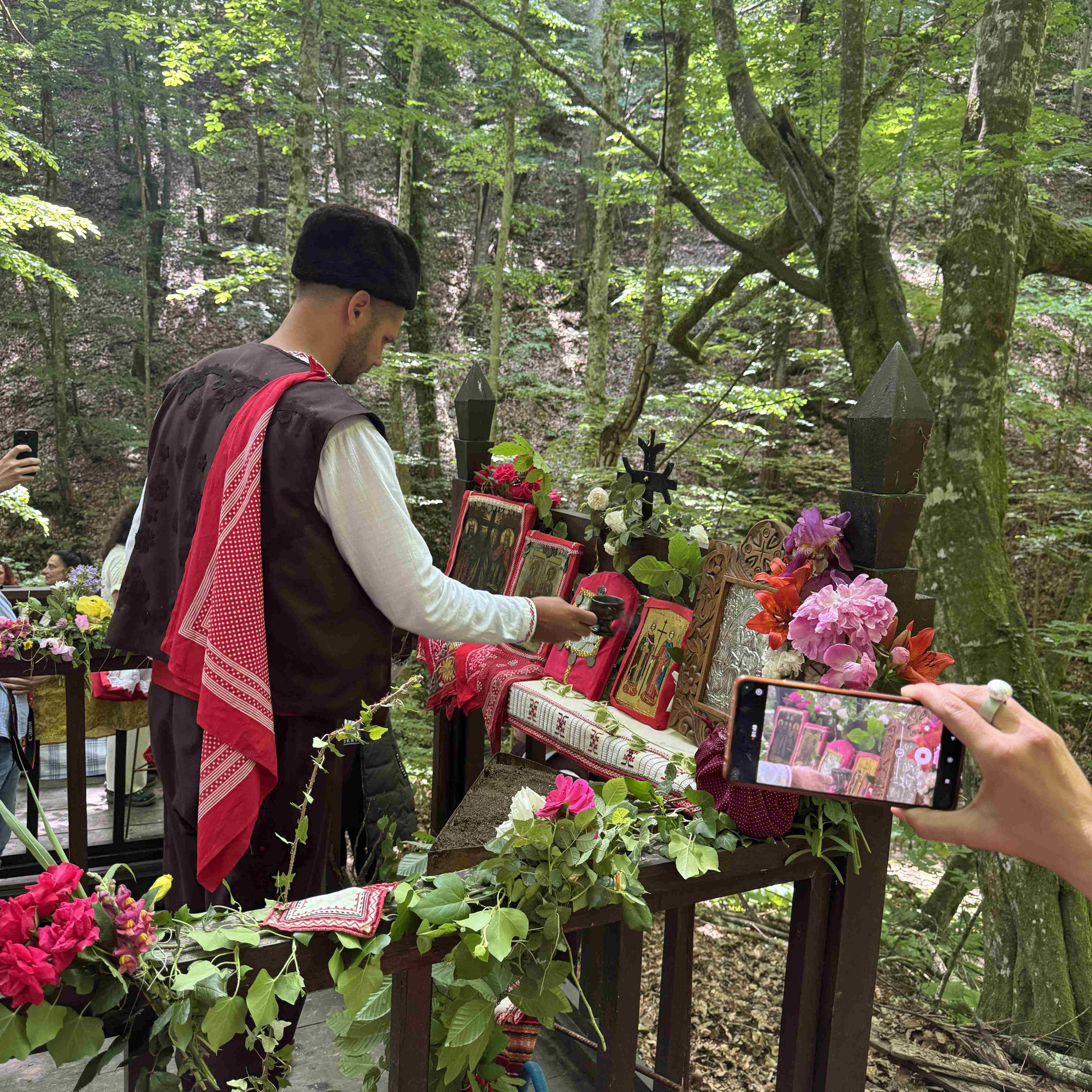
The actual peak of the ritual calendar is June 3rd, the feast day of Saints Constantine and Helen, when the grand main ritual takes place in the neighboring village of Balgari. However, the essential preparation occurs on the Sunday before: the washing of the icons in a holy spring deep within the forests of the Strandzha Mountains. For the village communities of Kosti, Balgari, Slivarovo, Gramatikovo, and Kondolovo, this Sunday marks the emotional prelude. In a solemn procession, they retrieve the icons from their chapels.
As early as nine in the morning, the village square in Kosti begins to fill with cars. People in outdoor gear and others in traditional attire arrive – some outfits historically faithful to traditional costumes, others leaning toward a modern folklore look. There is the joy of reunions, lively conversations – the kickoff to both a village festival and a religious ritual.
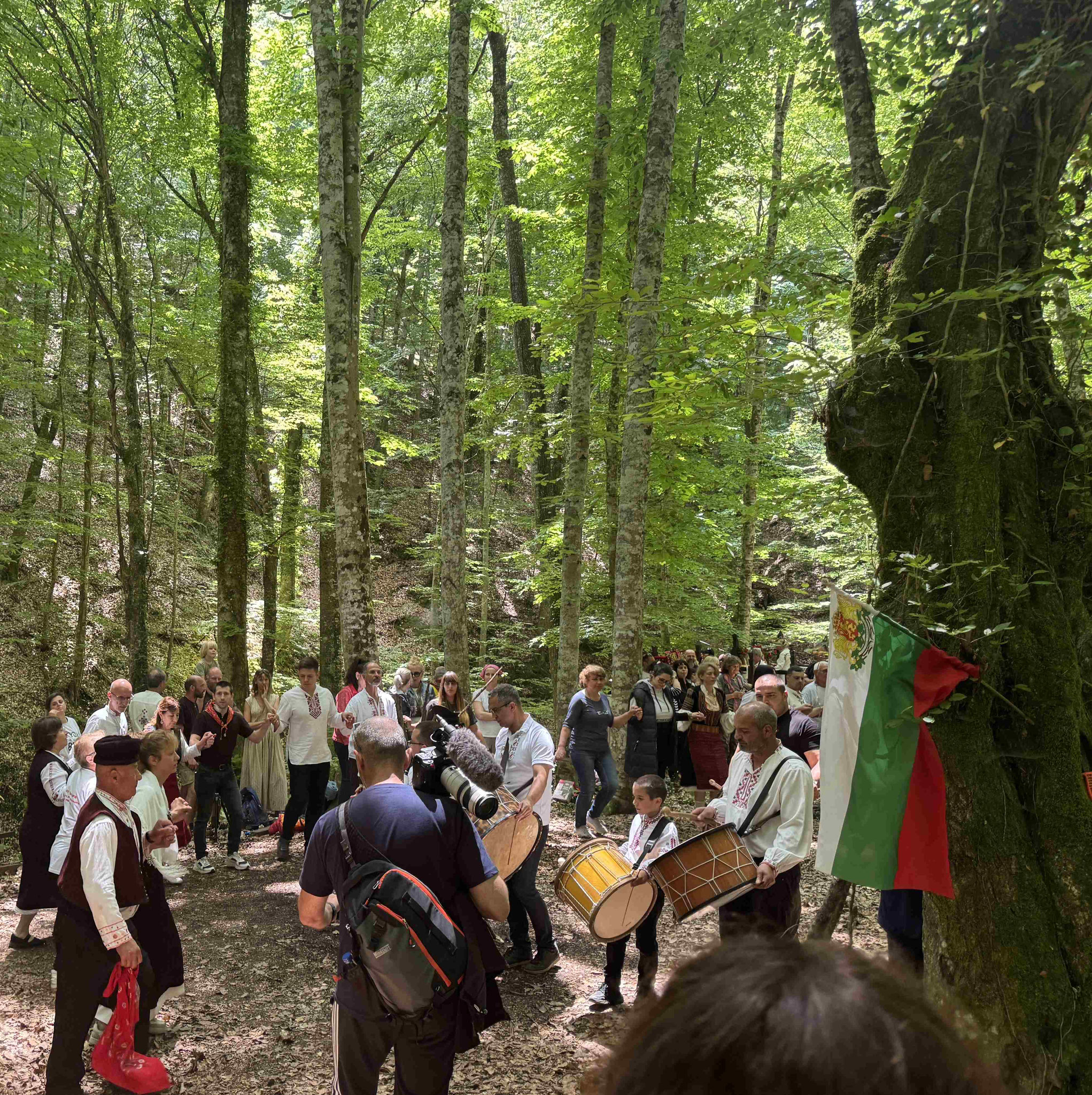
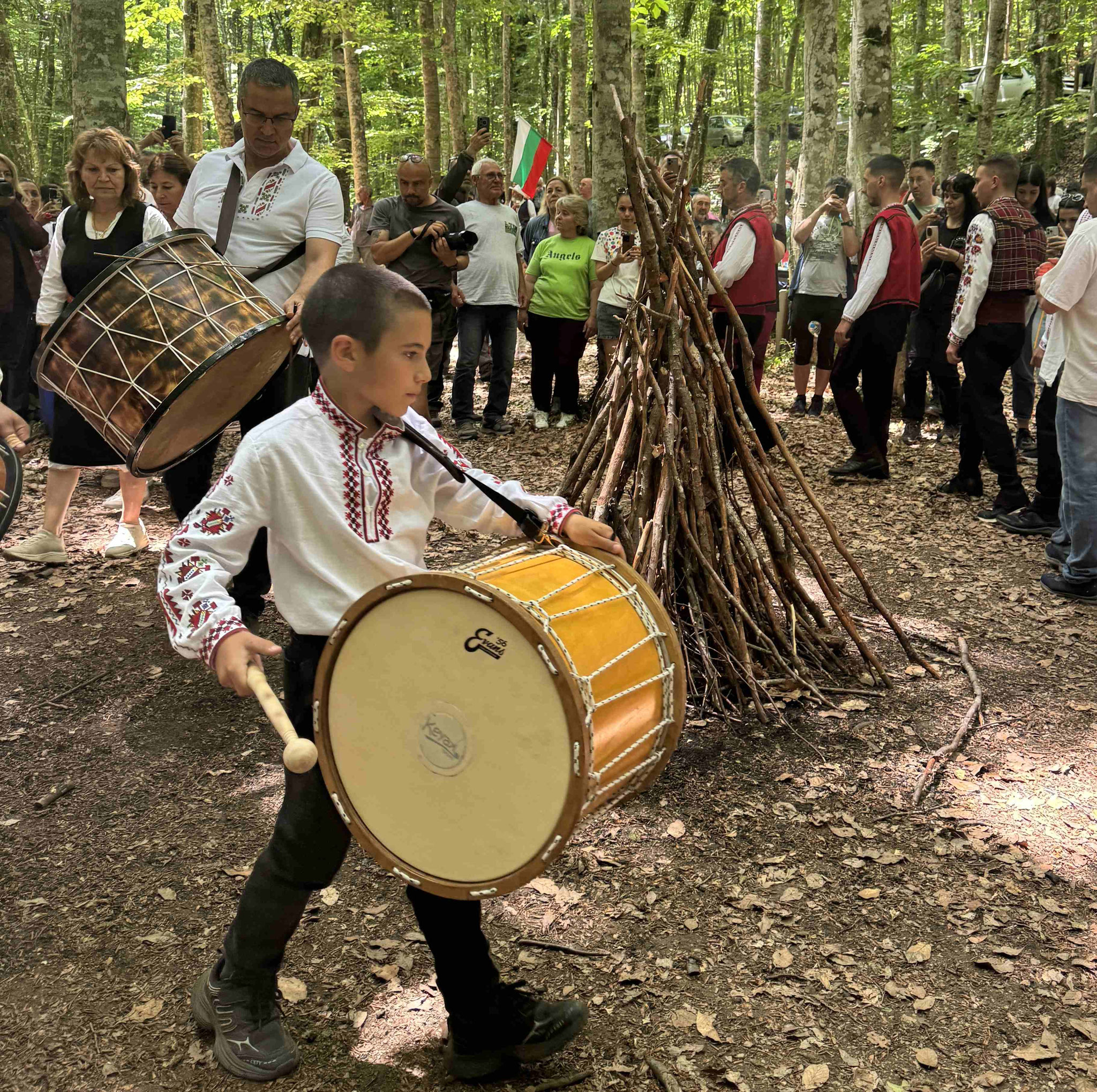
At ten o’clock, a rhythmic drumming begins on the tapan, accompanied by the gaida, a type of bagpipe. The crowd moves out, passing the church and marching through the village to a small, very modest chapel. There, the icons are retrieved and carried back to the village square – always to the beat of the drum, always in the same monotonous rhythm. While people used to walk or ride donkeys through the forest to the holy spring, vehicles stand ready today. Many use their own cars, but a bus is also waiting. For about ten kilometers, the vehicle rumbles along an unpaved path through the dense greenery, branches repeatedly lashing against the windows.
Suddenly, hundreds of cars are parked bumper-to-bumper along the roadside. People from all five villages gather here at the holy spring for the ritual ceremony. They are joined by onlookers and interested visitors from all over Bulgaria, and even from Greece. While fire dancing was once widespread across Thrace, this tradition has survived in its original form only in the Strandzha Mountains.
A few hundred people sit at long wooden tables, brought-along camping tables, or spread-out picnic blankets. The tables are lavishly laden. A few grills smoke as meat sizzles. Over an open fire, a traditional lamb soup simmers. A local woman donated the ingredients out of gratitude because her granddaughter recovered after a long illness.
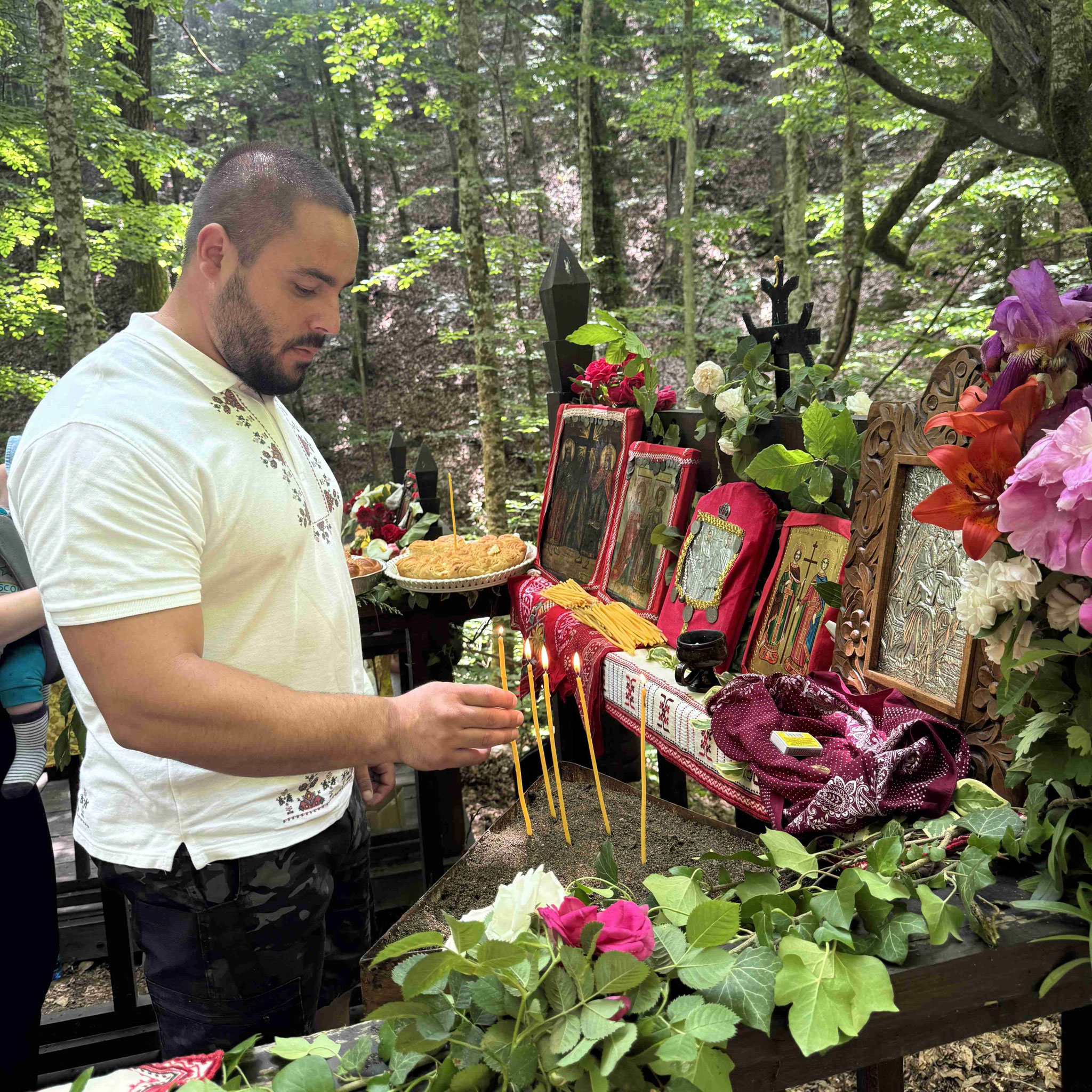
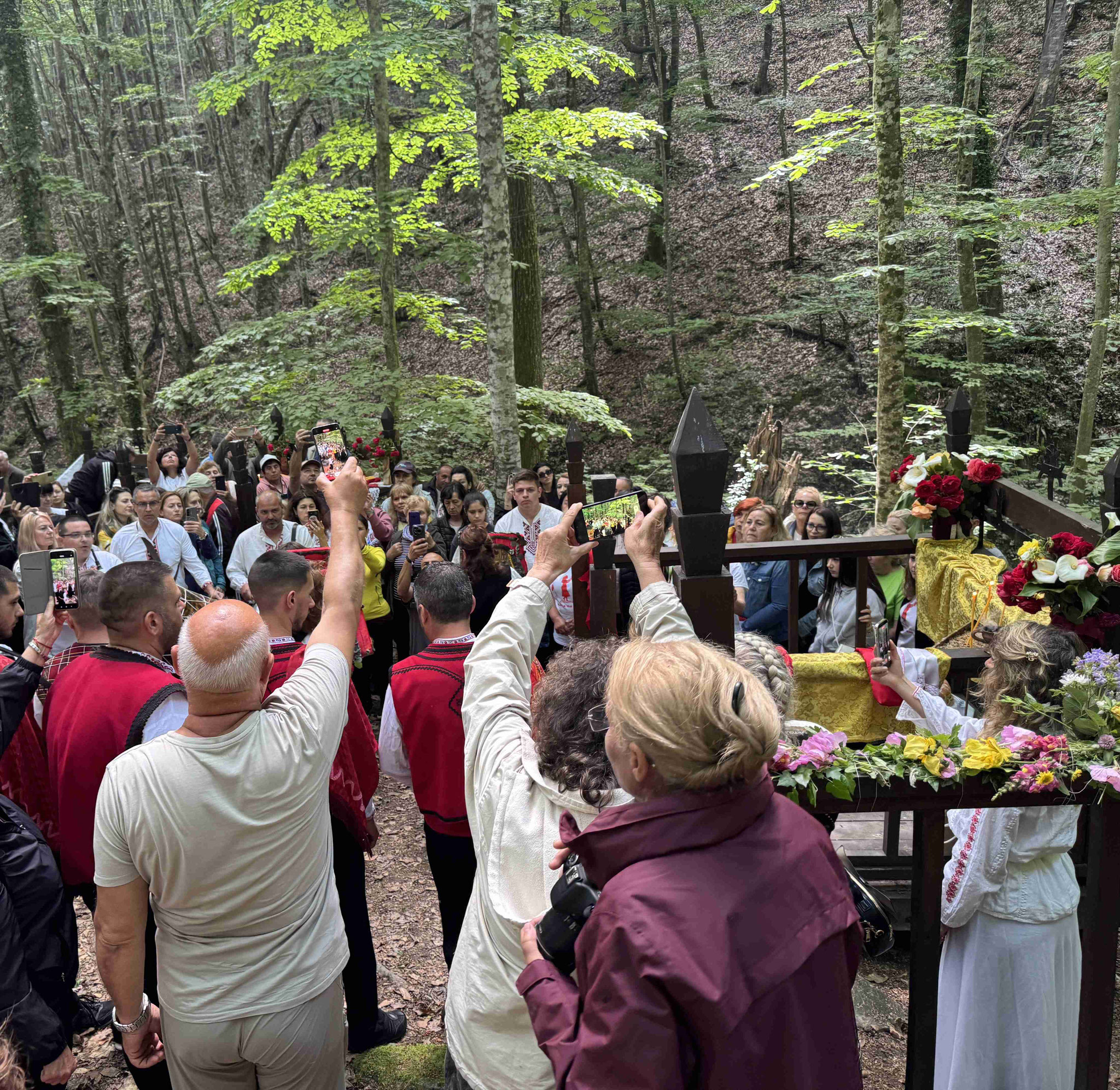
At the center of the action are five wooden altars, opulently decorated with flowers. Each village has its designated spot. And then it begins: to the constant, monotonous rhythm of the drums, each village carries its icons down to the spring, washes them, brings them back up, and places them on the altar. Candles are lit, incense clouds the air, and prayers are spoken. Individual visitors reverently enter the altar area one by one, while others jostle to get as close to the action as possible. Countless smartphones are held high to capture the moment.
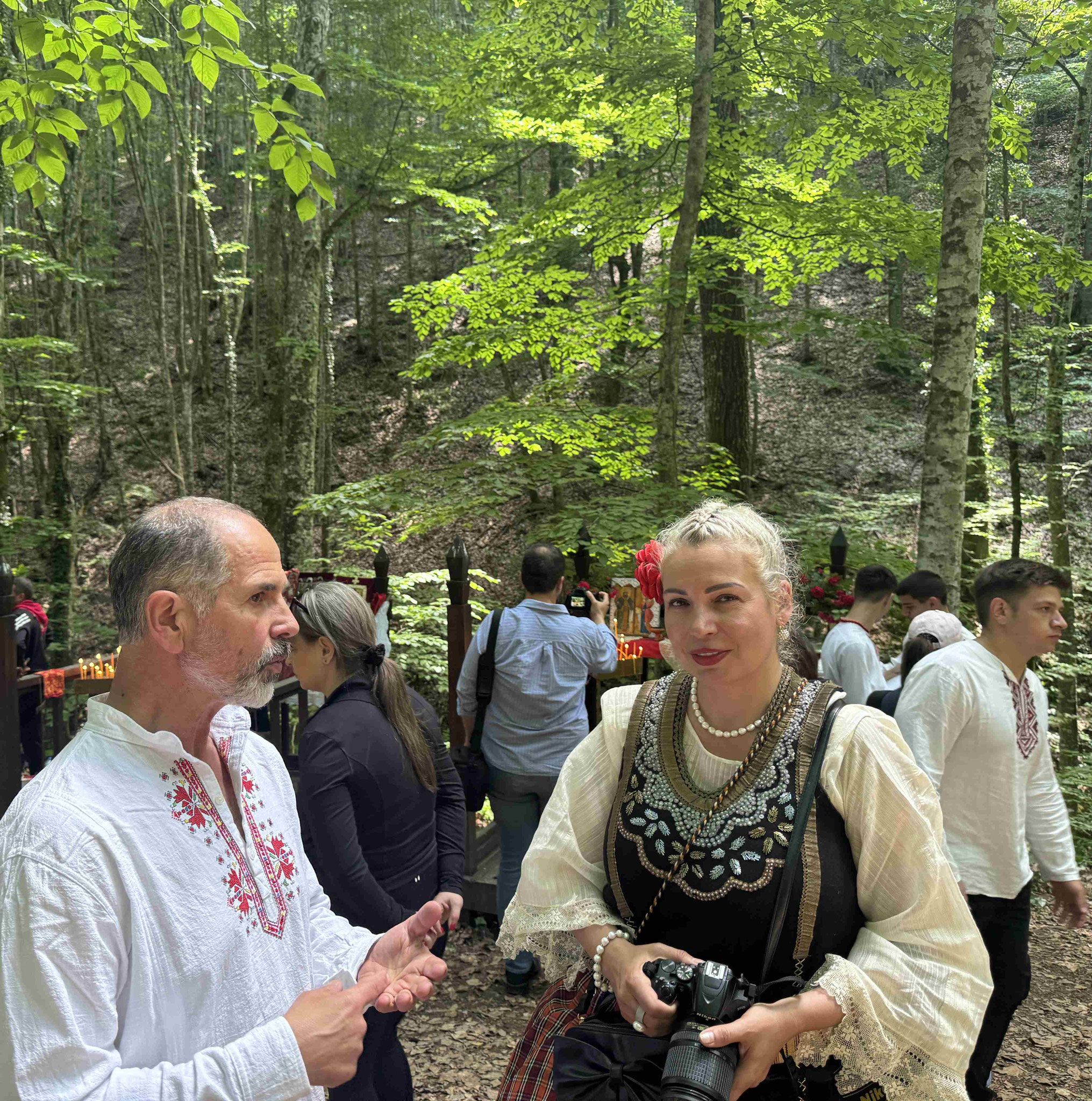
Amidst them is Lora Ilieva. She describes herself as an ethnographer and wears a striking traditional dress that stylistically blends various regions of Southern Bulgaria. Though Lora actually works in the financial sector, her passion belongs to the traditions of the Balkans. She emphasizes that Nestinarstvo is far more than just the fire dance itself – the actual step onto the hot embers: "Nestinarstvo is not folklore, it is not a staged show for tourists," she clarifies. "It is a millennia-old, deeply religious and spiritual system of culture and belief." Lora knows that the Church views this ritual of pagan origin critically. "But on the other hand, the icons come from the Christian Church. Furthermore, this tradition is older than the Church and older than Bulgaria itself." The custom even survived the communist era: although religion was effectively banned at the time, this ritual was tolerated.
The hours pass. People continually approach the altars, light candles, and bow before the icons. Children use the forest as a playground. Many go down to the spring and hold their hands in the holy water. Others simply sit at the long tables as if at a large family gathering or a village festival, eating, drinking, talking, and laughing. And above everything floats the music – again and again, the rhythmic drum and the bagpipe. The circle of people dancing to it grows larger and larger.
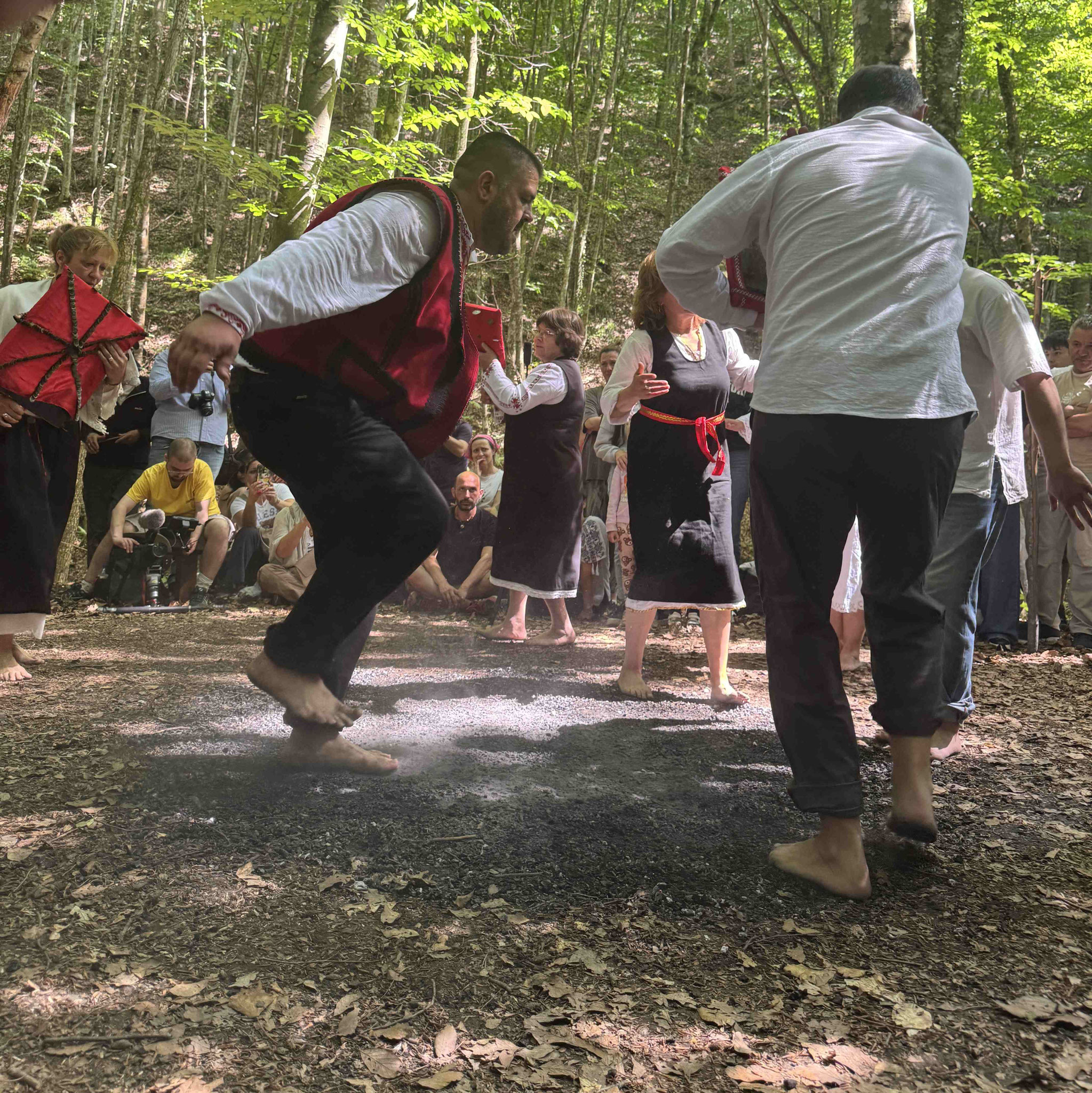
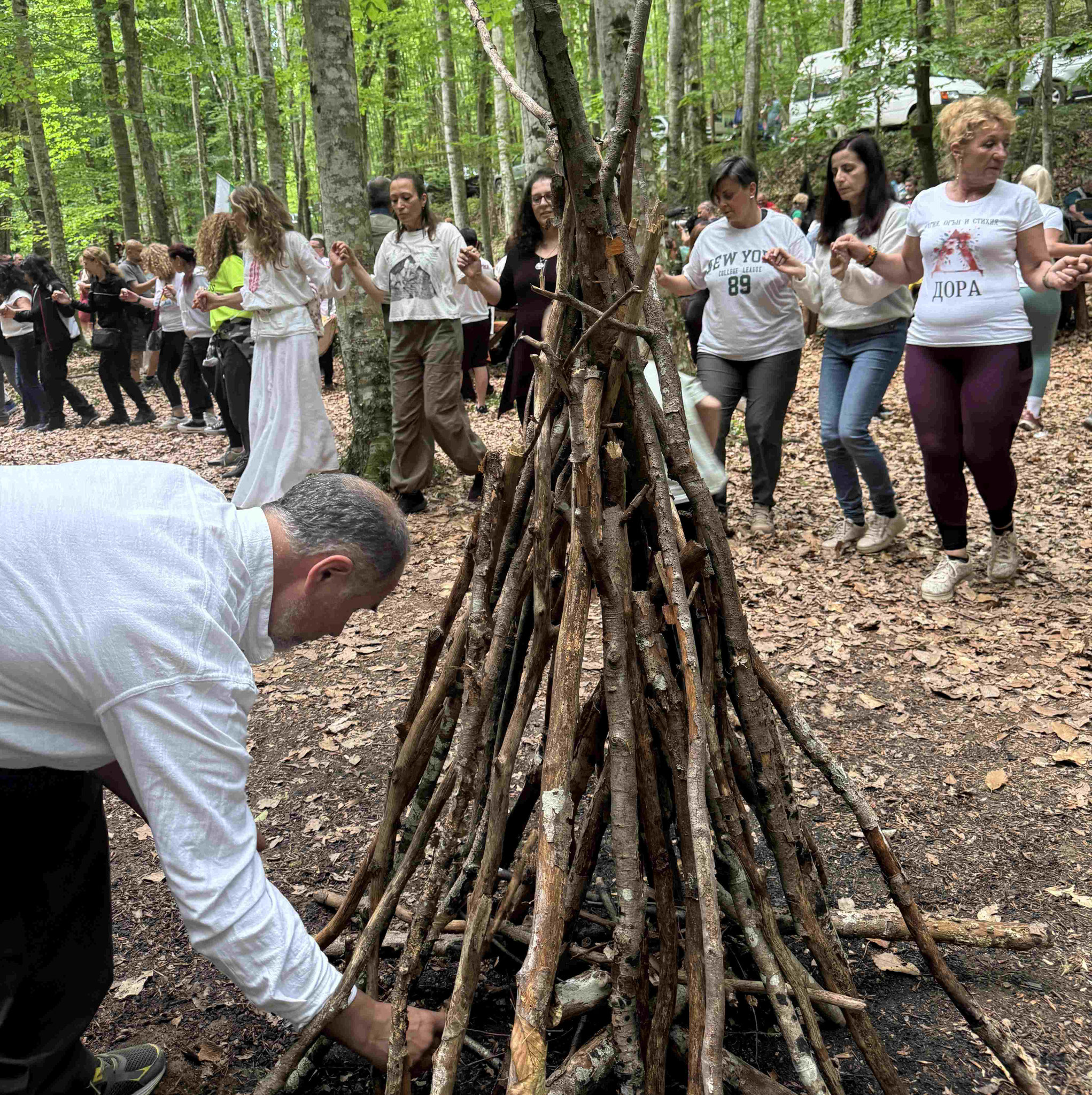
Finally, a fire pit is prepared and wood is piled high. Accompanied by music and dancing, the fire is lit. It slowly burns down until only glowing embers remain. The people in their traditional costumes gather at the altars once more. The icons are solemnly removed from the altars by their bearers and brought to the fire pit. Lora is also allowed to carry one of the icons. "It is a great honor for me to have been asked," she comments, visibly moved. She is a little nervous; one can sense how deeply rooted she is in this belief system. She explains that many people carry the ability to dance on the embers within them. "You just feel it when you can do it," she asserts. She talks about Nestinari whose facial expressions completely change the moment they dance: "They turn pale, their hands become ice-cold, they don't feel the pain, and they don't get blisters. I have danced in the fire too, and nothing happened."
She mentions attempts to explain the phenomenon scientifically. Yet, neither physicists nor psychologists have been able to fully solve the riddle of this heat insensitivity. The crucial factor, she says, is that the ceremony and dancing to the monotonous rhythm induce a trance-like state.
Her acquaintance, Ivo, joins the conversation: "One shouldn't look for a rational explanation, but rather try to experience and feel the ritual. The fire dance is only the climax. What matters is the preparation and the entire ceremony surrounding it." And Lora adds: "The circle of fire is a mirror of the sun, and the Nestinari – the fire dancers – create the connection between heaven and earth, between the gods and humanity."
Then the rhythmic beating of the tapan starts up again. The small procession of icon bearers and other "chosen" individuals sets off, moving toward the fire pit and forming a tight circle around the embers. And then, the first people – some holding icons, some with empty hands – step away from the crowd and dance right through the glowing embers. They are surrounded by observers who silently witness this fascinating custom suspended between religion and spirituality, between living faith and ancient, pagan tradition. Following this climax of the day, a sense of departure sets in. People slowly pack up their belongings. The cars rumble back to their respective villages, leaving the forest and the holy spring behind to the silence of nature.