Anyone listening to Valeri from Svilengrad quickly realizes: here speaks a man whose biography is deeply interwoven with the upheavals of Eastern Europe in the 20th and 21st centuries. Born in 1962 about 100 kilometers north of Svilengrad, the now 63-year-old looks back on a turbulent life.
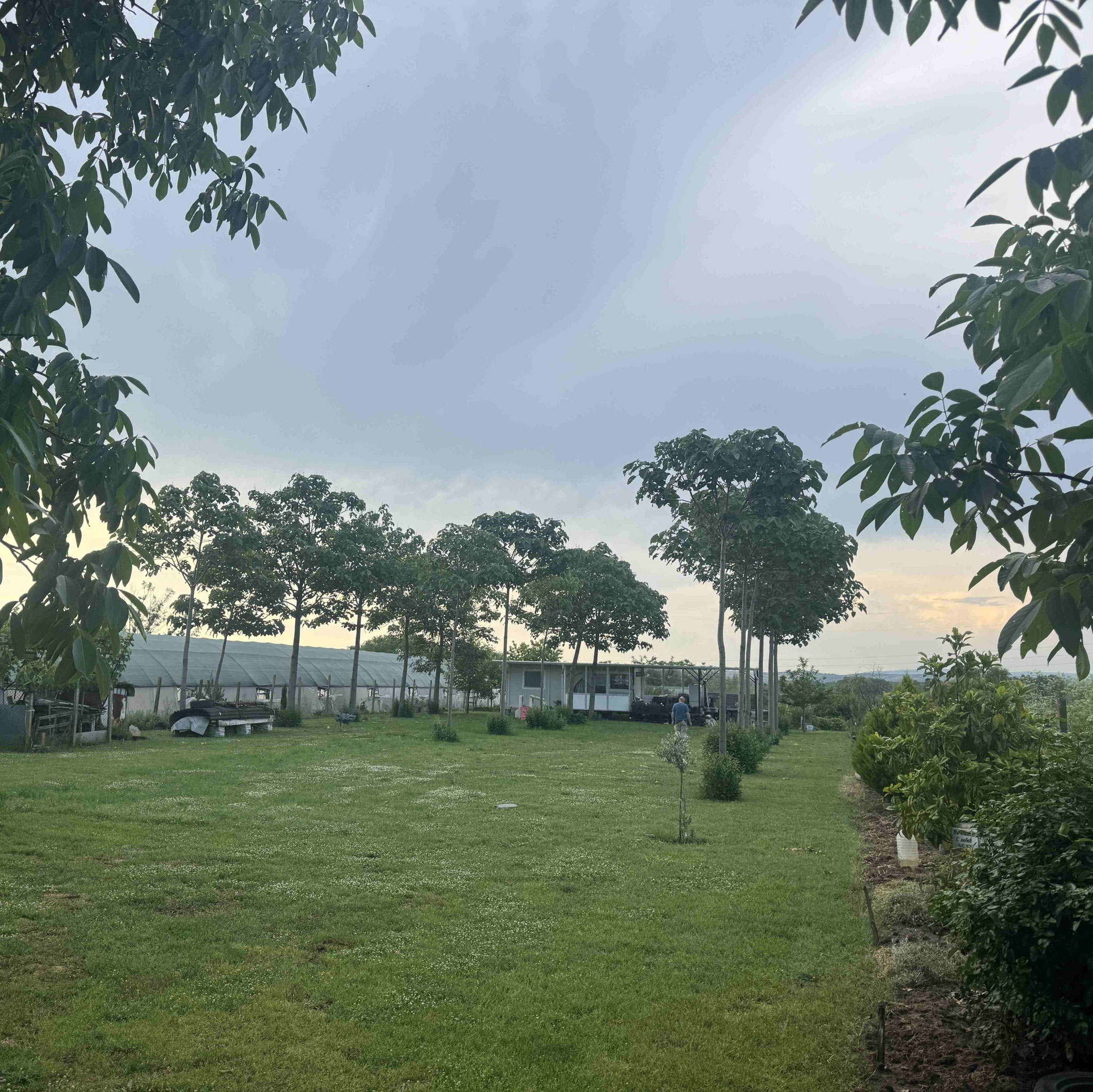
Despite all the crises and historical change, Valeri remains deeply connected to his homeland. "I have always had a good life in Bulgaria," he says with a satisfied smile. He sits on the terrace of his garden house, in the middle of a spacious property. It is an idyllic place - half a park with large trees and lush lawns, and the other half a vibrant kitchen garden full of vegetables, berries, fruit trees, grapevines, and his own greenhouse. Valeri calls this sanctuary his "vila" - a place that demands a lot of work from him, but above all brings him deep joy.
Valeri is a veterinarian. He runs his own small animal practice in Svilengrad, a city in a strategic and historically shaped location - just 17 kilometers from the Turkish border and three kilometers from the Greek border.
Valeri is well-known in the region. Walking through the streets with him, you quickly notice how deeply rooted he is in the community. Time and again, passers-by call out: "Doktore!" He is warmly greeted everywhere, shakes hands, and always takes time for a brief conversation. "A client of mine," he explains afterward.
However, everyday life as a veterinarian in rural Bulgaria also brings economic challenges. That is why, in addition to his practice, Valeri has also been running a pet shop since the 1990s. With his characteristic pragmatism, he makes it clear: "I couldn't live on my earnings as a veterinarian alone. People are not willing to pay as much money for a vet as they do in Germany."
As a Veterinary Student to the GDR
The love for animals and veterinary medicine was practically in Valeri's blood, as his father was also a veterinarian. Valeri's fascination with this profession began in childhood: he accompanied his father from an early age and, even as a young boy, was out and about with him in the livestock barns of the region.
At the same time, the family history is closely interwoven with the border region - his grandfather already came from a village near Svilengrad. His own childhood memories of the border are vivid, even if he did not yet understand the full extent of the political situation as a little boy: "The first time I was in Svilengrad was as a child of five or six. But I didn't know anything about the border back then."
Valeri talks about his university days studying veterinary medicine in Stara Zagora starting in 1980. The first time he visited Germany was in 1985 as part of a student brigade in Leipzig. "The work was only symbolic. The idea was for students from different socialist countries to establish contacts." Besides Russian, Valeri had also learned German at school, so communication was not a problem for him.
For him, it was a carefree and happy time: "We were young, the people were fun, and we had a good time together. The most important thing for me was being together with the other people from different countries." He remembers long nights and the socializing. At the time, he perceived the GDR as being much better organized than his home country. "In Bulgaria, people always say that Germans are boring and don't know how to enjoy life. In Bulgaria, we party late into the night and still go to work in the morning. From the Germans, you always hear the excuse that they have to work tomorrow." He talks about his various trips to Germany, especially to Weferlingen - Svilengrad's twin town. "I met so many open, cheerful, and friendly Germans there."
A Passion for Esperanto
Traveling abroad was not a problem for Valeri even before the political turning point. He even speaks enthusiastically about a trip to Copenhagen in 1983 for an international Esperanto congress. As a student, Valeri discovered his passion for Esperanto, which connected him with people from all over the world. For him, it was a window to the world that allowed for international exchange despite the Iron Curtain.
He proudly notes that there was also an international Esperanto congress in communist Bulgaria. "At the international congress in Copenhagen, people from so many countries came together and everyone could understand each other," beams Valeri, who was allowed to represent Bulgaria back then. He is still proud of that today. He regrets that Esperanto did not establish itself as a common global language.
A Critical View of the Peaceful Revolution
As positively as Valeri experienced the community under socialism, he views the political structures and the transition to democracy just as critically. His own father was a member of the Communist Party for 52 years, but the relationship with power was complicated: "My father was a member of the Communist Party, but he had many troubles with the party because he stood up for his own opinion."
When Valeri looks back at history today, he also reflects on how differently historical events can be interpreted. "History can be interpreted differently depending on politics," he points out - depending on who is telling it and from which perspective. As an example, he mentions the extremely close relationship with the Soviet Union at the time. Today, he looks back with a sense of realism, noting that during the era of state leader Todor Zhivkov, Bulgaria essentially acted like the "16th Republic of the USSR." And yet, he emphasizes, he perceived everyone as peaceful back then, including the Russians, even though he himself has never been to Russia.
When the protests in 1988 and the historic turning point of 1989 shook the country, Valeri was right in the thick of it. But in hindsight, his hope for real change was bitterly disappointed. He draws a sharp line between the honest people on the street and those who profited in the end. "The people on the street, and I too, wanted change. 45 years are enough," he says, quoting the famous slogan of the nationwide protests at the time. "But the people who led these protests were not good people." Valeri becomes very clear on this point: "Some of them were party members who organized the protests. It was clear that the communist party would have no power in the future, so they had to organize the change. But these leaders were concerned with securing their own privileges and wealth. And many managed to save their own skins. Many are wealthy businessmen today," Valeri summarizes, using a Bulgarian proverb: "The wolf changes his fur, but not his nature."
From Kapitan Andreevo to the Fate of the Refugees
The theme of the border has not only accompanied Valeri in his private life but also significantly shaped his professional career: for many years, he worked as a veterinarian directly at the important Kapitan Andreevo border crossing - the bottleneck between Bulgaria and Turkey. Through this work and his current practice in the tri-border area, the border remains a part of his everyday life to this day.
To him, a state border is an unshakeable principle: "A state border is important. A border is a border - whether there are fences or not. It must not be crossed. And to control that, there is the Bulgarian border guard. We locals live with it. It is normal for us."
At the same time, he remembers the tragic escape attempts during the Cold War, when people from other socialist countries tried to reach the West via the Bulgarian border: "Many people died - not only Bulgarians, but also Germans and people from other socialist countries." Regarding today's situation, he says: "The refugees are stopped and placed in special camps in the region. Then a decision is made as to whether they can continue to Western Europe, which is where most want to go, or not."
Valeri also has a clear opinion on current global political events, such as the war in Ukraine. He distances himself from arms deliveries and advocates for diplomacy. He sees economic interests as the main driver of the war: "A lot of money is made with weapons, which is why many have no interest at all in the war ending."
Concerns About the Euro and the Changing Homeland
When Valeri looks at today's Bulgaria, skepticism mixes into his words. The planned introduction of the Euro causes him particular concern. He fears that with the Euro introduction in Bulgaria at the beginning of the year at a fixed rate of about 2 Lev per Euro, many prices will be rounded up in practice, causing small savings in particular to lose real purchasing power.
He also views the social fabric in the country with concern and sees unequal treatment, especially regarding support for refugees compared to the often poor local population: "People in Bulgaria do not speak well of refugees from Ukraine. They believe they get too much money while some people in Bulgaria are getting poorer and poorer." For him, one thing is certain: "Refugees are people in need, but these are not refugees."
Furthermore, he shakes his head at the recent development of his hometown, Svilengrad, which has turned into a gambling hotspot due to the legal situation in neighboring Turkey: "There are so many casinos in Svilengrad because gambling is banned in Turkey." He also talks about investors from Turkey who are investing heavily in Svilengrad. He strongly doubts whether this development will be positive for the city in the long term.
In contrast, it is with visible pride that he shows the true treasures of his homeland: the famous, historic Mustafa Pasha Bridge, which dates back to Ottoman times and majestically spans the Maritsa River - a symbol of permanence amidst the constant shifts of history.